

Learning from Eco-social Approaches to Public Health
At LEAPH, we are continually inspired by the ways that students and trainees contribute to understanding the complex relationships between people, places, ecosystems, and health. This year, we are delighted to celebrate two important milestones within our community: Jonathan Doyon's completion of his Master of Science in Health Sciences and Christiana Onabola's completion of her PhD in Health Sciences.
Although their research journeys have explored different questions and contexts, both scholars exemplify LEAPH's commitment to interdisciplinary, place-based, and equity-oriented approaches to health research.
Jonathan Doyon's work has focused on elevating youth voices and experiences within watershed contexts, exploring how engagement with place can contribute to healthier futures for communities and ecosystems. Throughout his time with LEAPH, Jonathan has contributed to initiatives including Climate Health Co-Benefits, the Nechako Watershed Portal, and Koh-Learning in Our Watersheds. His research reminds us that young people are not simply future leaders; they are active participants in shaping resilient and flourishing communities.
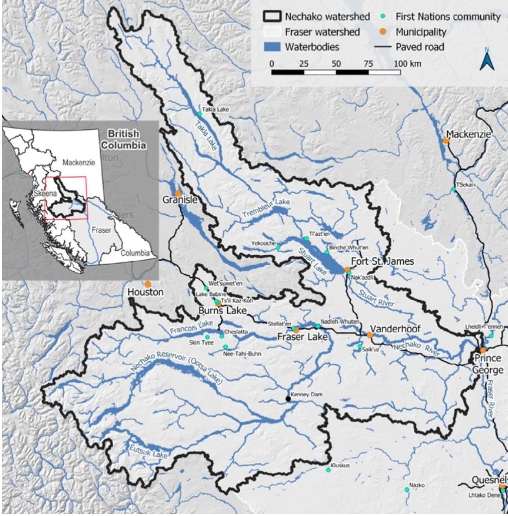
Christiana Onabola's doctoral research has deepened conversations about health equity, environmental change, and the social and ecological determinants of health. Focusing on how complex systems, such as land, water, and energy, intersect with health and well-being in rural, remote, and resource-dependent communities, her work explored how governance decisions and environmental changes associated with the Kenney Dam in the Nechako watershed of northern British Columbia have influenced community well-being across generations. Drawing on an analysis of more than 70 years of history in the watershed, her scholarship offers an integrative approach to trace how large-scale environmental and governance decisions ripple through communities, disrupting the everyday relationships, cultural practices, food systems, and sense of belonging through which people sustain their health and identity. Her work also demonstrated how the Sustainable Development Goals (SDGs), when localized in resource-dependent settings, can be restructured into powerful tools for systemic accountability, making hidden inequities visible and shining a light on the experiences and priorities of communities that are often overlooked in standard data systems and conventional approaches to development and decision-making.
Together, their accomplishments reflect the breadth of scholarship within LEAPH: research that crosses disciplinary boundaries, values multiple ways of knowing, and seeks practical pathways toward healthier, more equitable, and sustainable futures.
We extend our warmest congratulations to Jonathan and Christiana on these significant achievements. We are grateful for the insights, curiosity, collaboration, and leadership they have brought to the LEAPH community and look forward to seeing how their work continues to contribute to planetary health research and practice.
We invite you to learn more about their research journeys by exploring their LEAPH profiles and accessing their theses below.